View in a room
Share
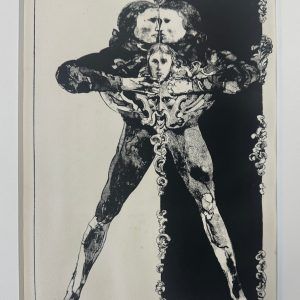
A Skeleton, Back View, Standing with Left Arm Extended
Unframed size: Not available
$2,450.00
Taxes and shipping fees will apply upon checkout

View in a room
Share
Unframed size: Not available
Taxes and shipping fees will apply upon checkout
A plate from Berhard Siegfried Albinus’ famous “Tabular Sceleti et Cusculorum Corporis Humani”, etched by Jan Wandelaar from his own drawing.
Tabulae Sceleti et Musculorum Corporis Humani was arguably the most important illustrated anatomical work of the Eighteenth Century. Anatomist Bernhard Siegfried Albinus and artist Jan Wandelaar collaborated closely to create engravings that were scientifically accurate and exceptionally visually appealing.
Albinus insisted on scientific accuracy. He insisted that images should be reproduced “not free hand (according to the view), as is customary, but from actual measure”. Therefore, he and Wandelaar carefully composed each rendering to find the point of view from which the anatomy could be best viewed. They took pains to depict them in accurate proportions and to shade them to convey their three-dimensional form. They invented a complex process which involved supporting the specimens with stands and cords attached to the walls and ceiling while checking the accuracy of the poses against a thin male model who posed nude in the same position. They also viewed the specimens through a gridded net to capture the precise proportions. This process was so painstaking that it took 20 years to complete the 40 plates of the Tabulae, which were completed in 1740 and published in Leiden in 1747. (A British edition was published in London by John and Paul Knaption in 1749.)
The anatomical figures were placed in lush, elaborate Baroque landscapes and architecture, giving the figures a spatial context, added aesthetic interest, and created an illusion of vitality.
Prior to meeting Albinus, Jan Wandelaar was already an accomplished natural history artist. He studied with Dutch printmaker Jacob Folkema, Dutch engraver and mapmaker Gillem van der Gouwen, anatomical artist Gérard de Lairesse, and botanist and anatomist Fredrik Ruysch.
Albinus believed so strongly in the work that he is said to have spent around 30,000 florin—about $5.5 million today, depending on how it is calculated—to produce it. His investment provided plates that are incomparable and widely considered to rank among the best in engraving history.
This work has been custom framed using strictly conservation-grade materials behind 99% UV-blocking art glass. The print exhibits a horizontal crease near the center, as is typical of these prints, presumably from the paper being hung over a line to dry.
| Attributes | Value |
|---|---|
| Attribution Class |
Unknown Edition |
Medium:
Etching And Engraving On Wove Paper
Date:
1740
Framed Size:
Attribution Class
Unknown Edition
Sheet Size:
22 in. (h) x 15.375 in. (w) x

$575.00

$2,000.00

$1,100.00

$1,295.00



Buy art, support creativity.

Guaranteed genuine artwork.

Free delivery on orders $99+.
Established in 2017, Washington Color Gallery
presents exceptional works by Washington artists
and renowned printmakers worldwide.




Company

Washington Color Gallery
7979 Old Georgetown Road, Suite 1100
Bethesda, MD 20814, United States